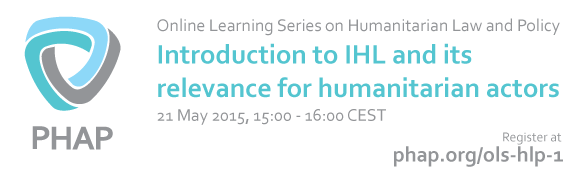
International humanitarian law (“IHL”) aims to regulate the behavior of those involved in armed conflict. Though formally it binds states and armed groups, it also has great practical relevance to humanitarian actors. It provides a set of principles, rules, and norms that govern a myriad of activities, including the conduct of hostilities, detention operations, and humanitarian assistance efforts. As a legal framework, it is relevant to a range of activities in the humanitarian sector – for operations, research, advocacy, communications, etc.
This session will look at examples of practical situations in which an understanding of IHL is critical for those working in the humanitarian field and will address the following questions:
- What is IHL, what is its aim, and why is it important for humanitarian actors to understand?
- Under what conditions does IHL apply and what are the consequences of its application?
- What are the main sources of IHL? Who has rights and obligations under IHL?
- What is the relationship of IHL to other bodies of law relevant to humanitarian practice, particularly human rights law and refugee law?
This online session, the first in a series of regular online events bringing together humanitarian practitioners for brief expert lectures and open Q&A, will provide an overview of IHL with a focus on its significance for humanitarian actors.
Learning objectives
- Awareness of the different kinds of actors for whom international humanitarian law (IHL) is a relevant framework
- Identification of professional contexts and roles that call for familiarity with IHL
- Basic understanding of the conditions that trigger the application of IHL, and the implications for both civilians and belligerents
- Familiarity with the basic sources of IHL rules, namely multilateral treaties and customary international law
- Recognition of the basic rules and principles of the IHL framework
- Understanding of IHL within the broader context of public international law
Prerequisite knowledge
None
Recommended readings
For participants wishing to prepare in advance for the event, we recommend the following resources:
- Marco Sassòli, Antoine Bouvier & Anne Quintin, How Does Law Protect in War, Fundamentals of IHL (book chapter)
- Danish Red Cross, Handbook on the Practical Use of International Humanitarian Law, Thinking About Protection (book chapter)
- ICRC, International Humanitarian Law: Answers to Your Questions
PHAP members are also recommended to follow the PHAP Online Course on Essentials of International Humanitarian Law, in particular the introductory modules on Public International Law and International Humanitarian Law.
Assessment
PHAP members will have the possibility to undergo a two-part assessment after the session as part of the PHAP Continuous Learning Credits framework.
Part 1: Knowledge-based assessment
Part 2: Brief essay
Target audience
Humanitarian practitioners as well as others with a professional or general interest in humanitarian action in situations of armed conflict.
Event access
The live event on 21 May 2015 is open to the public. Advance registration is required at phap.org/ols-hlp-1/register. PHAP members will also have access to the recording of the event.
Session time
Thursday, 21 May 2015
| New York: |
09:00 - 10:00 |
| London: |
14:00 - 15:00 |
| Geneva: |
15:00 - 16:00 |
| Amman: |
16:00 - 17:00 |
| Nairobi: |
16:00 - 17:00 |
| Bangkok: |
20:00 - 21:00 |
| Manila: |
21:00 - 22:00 |
To see when the live session will take place in your time zone, click here
Speaker
|
 Elizabeth Holland
Consulting Expert on International Humanitarian Law, International Association of Professionals in Humanitarian Assistance and Protection (PHAP)
|
Event host
|
 Angharad Laing
Executive Director, International Association of Professionals in Humanitarian Assistance and Protection (PHAP)
|
|