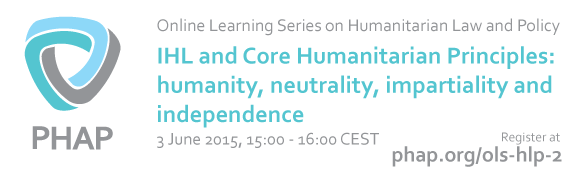
The four core humanitarian principles – humanity, impartiality, neutrality, and independence – undergird the humanitarian enterprise. They are referenced in UN Resolutions, included in the Red Cross and NGO Code of Conduct, cited in the missions and mandates of various organizations, noted in various best practices documents, and included in a number of donor agreements. Consequently, considerations regarding how to operate in accordance with these principles are of great import for humanitarian organizations.
This session will review the four core principles in detail, discussing their definitional scope, the guiding role they play, and give a brief overview of the challenges to their implementation. It will also contextualize the principles by examining their relationship to international humanitarian law (IHL), focusing in particular on their significance to those negotiating and conducting humanitarian operations in the context of an armed conflict.
Later this year, this session on the basics of the core humanitarian principles will be followed by a series of more advanced sessions focusing in greater depth on each principle, as well as challenges, and dilemmas in their operationalization.
Learning objectives
- Understanding of the four core principles of humanity, impartiality, neutrality, and independence and the ways in which they are linked in practice
- Awareness of other operating principles used by humanitarian actors
- Understanding of the relationship between the core humanitarian principles and international humanitarian law (IHL)
- Awareness of the limited scope of humanitarian assistance and access under IHL
- Ability to analyze the dilemmas faced by humanitarian organizations when operationalizing the humanitarian principles
Prerequisite knowledge
No prerequisite knowledge.
The following online learning session is recommended (recording available for PHAP members):
OLS HLP Session 1: Introduction to IHL and its relevance for humanitarian actors
Recommended readings
For participants wishing to prepare in advance for the event, we recommend the following resources:
PHAP members are also recommended to follow the PHAP Online Course on Essentials of International Humanitarian Law.
Assessment
PHAP members will have the possibility to undergo a two-part assessment after the session as part of the PHAP Continuous Learning Credits framework.
Part 1: Comprehension check
Part 2: Written reflection
Target audience
Humanitarian practitioners as well as others with a professional or general interest in humanitarian action in situations of armed conflict.
Event access
The live event on 3 June 2015 is open to the public. Advance registration is required at phap.org/ols-hlp-2/register. PHAP members will also have access to the recording of the event.
Session time
Wednesday 3 June 2015
| New York: |
09:00 - 10:00 |
| London: |
14:00 - 15:00 |
| Geneva: |
15:00 - 16:00 |
| Amman: |
16:00 - 17:00 |
| Nairobi: |
16:00 - 17:00 |
| Bangkok: |
20:00 - 21:00 |
| Manila: |
21:00 - 22:00 |
To see when the live session will take place in your time zone, click here
Speaker
|
 Elizabeth Holland
Consulting Expert on International Humanitarian Law, International Association of Professionals in Humanitarian Assistance and Protection (PHAP)
|
Facilitator
|
 Angharad Laing
Executive Director, International Association of Professionals in Humanitarian Assistance and Protection (PHAP)
|
|