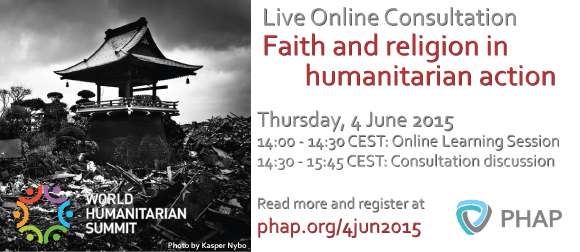
On 4 June 2015, PHAP will host a special online consultation event on “Faith and religion in humanitarian action: Improving cooperation and effectiveness” in support of the World Humanitarian Summit.
´
Religious discourse has long been characterised by a concern for the immediate welfare of humankind, and faith-based organization play an important role in mobilizing the support of millions of people for whom religious values underpin their concern for their neighbours in the global village. Faith-based organizations can play a particular role where overt conflicts or less overt inter-group grievances are exacerbated by religious tensions, especially in bridging social or political divides with distinct religious dimensions.
Many humanitarian actors, defend their religious neutrality claiming that they can gain better access and offer unconditional help to people in need whoever and wherever they are. On the other hand, a majority of faith-based organizations do not see any incompatibility between their actions and the humanitarian principles of neutrality and impartiality. They highlight that they provide humanitarian assistance without proselytizing to those in need and regardless of their faith and that they can gain better access in certain contexts.
Following the Symposium on “Religions Together for Humanitarian Action,” hosted by the Order of Malta in Geneva, the International Association of Professionals in Humanitarian Assistance and Protection (PHAP) will host a live online consultation in support of the World Humanitarian Summit focusing on the challenges and opportunities faced by faith-based humanitarian organizations and how we can overcome the obstacles hindering faith-based and other organizations from working more closely together.
The event will focus on the following questions:
- What are the particular challenges that faith-based humanitarian organizations face in their work?
- Do faith-based organizations have a unique role to play in humanitarian action or should their grounding in religion be downplayed?
- What are the main obstacles hindering faith-based and other organizations from working more closely together?
The event will be directly preceded by a 30-minute Online Learning Session with Alistair Ager on religion in humanitarian action. Participants are encouraged to participate in both the learning session and the consultation event.
Registration
The event is open to the public but advance registration is required. You can register for the learning session and the ensuing World Humanitarian Summit live online consultation on the same registration form. You are also able to use the registration form to submit questions and comments that will feed into the consultation.
Event time
Thursday, 4 June 2015
| New York: |
08:00 - 09:45 |
| London: |
13:00 - 14:45 |
| Geneva: |
14:00 - 15:45 |
| Amman: |
15:00 - 16:45 |
| Nairobi: |
15:00 - 16:45 |
| Bangkok: |
19:00 - 20:45 |
| Manila: |
20:00 - 21:45 |
To see when the live session will take place in your time zone, click here
Panelists
|
 Michel Veuthey
Deputy Permanent Observer of the Order of Malta to the UN in Geneva and Vice-President of the International Institute of Humanitarian Law
|
|
Amjad Mohamed-Saleem
Consultant and member of the World Humanitarian Summit thematic team for Humanitarian Effectiveness
|
|
 Alastair Ager
Professor of Clinical Population and Family Health at the Mailman School of Public Health, Columbia University
|
|
Additional panelists to be announced
|
Facilitator
|
 Angharad Laing
Executive Director, International Association of Professionals in Humanitarian Assistance and Protection (PHAP)
|
|